
Relational Therapy Practice Guide for Therapists and Psychologists
Updated: Apr 21

Introduction: Learning to Practise Relationally
Every therapist begins with methods. We learn structure, questions, interventions, and frameworks. Over time, something quieter and more profound emerges: the recognition that therapeutic change is carried not only by what we do, but by how we are in relationship.
Relational therapy is not a single technique.
It is a way of thinking, perceiving, and engaging with the person in front of us, shaped by culture, identity, context, and the moment-to-moment emotional field between therapist and client.
For trainees and early-stage practitioners, this can feel both inspiring and intimidating.
Common questions they ask are:
What does “use of self” really mean?
How do I balance authenticity with professional boundaries?
How do culture, power, and identity shape the relational field?
How do I grow from “doing therapy” to “being in relationship”?
This article offers a clear and reflective guide to the developmental process of becoming a relational therapist.
What Relational Therapy Is (and Is Not)
Relational therapy is often misunderstood as “talking about relationships” or “being warm.” In practice, it is the study of how people co-create meaning, emotion, expectations, and possibility within relationship, including the therapy relationship itself.
It draws from multiple traditions:
Relational Psychoanalysis (Mitchell, Stern)
Humanistic Psychology (Carl Rogers)
Relational–Cultural Theory (Jordan, Miller)
Attachment Theory (Bowlby)
Interpersonal and Experiential Therapy
Interpersonal Neurobiology (Schore, Cozolino)
Trauma-Informed Care
Cultural Humility and Multicultural Counselling
Across these perspectives, one principle remains consistent:
Therapy becomes transformative when the relationship is safe, attuned, reflective, and emotionally accurate.
✔ What relational therapy is
working with the live relational field
noticing patterns in real time
recognising mutual influence (with boundaries)
using presence, tone, pacing, and attunement as tools
acknowledging culture, identity, and power
viewing repair as central to change
✘ What relational therapy is not
unstructured or improvised
excessive self-disclosure
boundaryless or overly expressive
simply being kind
tied to one modality
an immediate shortcut to depth
Relational practice develops through training, supervision, ongoing reflection, and personal work.

What It Means to “Become” a Relational Therapist
Relational therapy is not a badge or a speciality. It is something gradually internalised over time.
It becomes a way of understanding attunement, cultural humility, ethical clarity, awareness of power, reflective practice, emotional steadiness, trauma-informed compassion, and flexible responsiveness.
Relational work emerges through sustained training, supervision, self-reflection, and personal therapy. It also grows through:
mentoring
cultural dialogue
community
lived life experiences
mistakes, courage, and repair
This is not a linear journey.
It is a lifelong, cyclical development.

Why Relational Work Must Consider Culture, Identity, and Power
The relational field is never neutral.
Every therapeutic encounter is shaped by:
ethnicity
gender
class and economic context
migration histories
language
family culture
region and community
social norms
experiences of privilege or marginalisation
For many clients and practitioners, migration stories, diaspora identities, and the emotional labour of living between cultures shape the relational field in powerful ways.
A relational therapist does not need to be an activist.
However, a relational therapist cannot be relationally accurate while blind to context.
Cultural humility, rather than cultural expertise, is the stance.
A relational stance assumes:
The client’s cultural world is part of their emotional world.
Power exists, even when unspoken.
Differences shape vulnerability and safety.
Culture is more than ethnicity; it includes class, community, and personal history.
Humility is safer than certainty.
Repair matters more than perfection.
Cultural curiosity is a form of care, not interrogation.
Positionality matters, not in an academic sense or political rhetoric, but as quiet, steady awareness of how who we are influences how we are experienced.
This reflects the heart of relational practice:
to see the whole person, including the world they come from.
The Relational Development Journey
Relational development does not come from one model alone. It emerges from patterns observed across several major frameworks that describe how therapists grow over time.
Across:
IDM (Stoltenberg and McNeill) with its focus on autonomy, confidence, and internal regulation
Rønnestad and Skovholt’s lifelong practitioner development
The Seven-Eyed Supervision Model with its emphasis on relational process, context, and use of self
…a shared developmental arc appears.
For a wider developmental view, see my breakdown of the Stages of Skills and Competence of a Therapist here: The Therapist’s Growth Journey: Understanding Your Development with the IDM Model
Although each model uses different language, they all describe similar movements in a therapist’s growth:
from technique to presence
from anxiety to grounded-ness
from self-consciousness to relational awareness
from cultural uncertainty to cultural humility
from rigid doing to flexible attunement
I tried to bring these strands together into one coherent, relationally focused developmental path, designed to be accessible for trainees and early-stage practitioners.
The framework below: the Relational Development Journey, does not replace any existing model. It synthesises what they collectively show us about how therapists grow into relational depth.
This visually presents a gentle cycle of five phases. These five phases form a gentle cyclical path rather than a hierarchy, and most practitioners move through them repeatedly as their relational capacity deepens.

Phase 1: “Doing Therapy” (Starting Stage)
Early-stage practitioners rely on:
questions
interventions
scripts and manuals
structure
supervision reassurance
This phase is necessary. Technique provides structure when confidence is still forming.
For example, asking ‘What did you do next?’ is technique; slowing the pace and saying, ‘What was happening inside you in that moment?’ is relational presence.
Common internal experiences:
“Am I doing this right?”
“What if I get it wrong?”
“What would my supervisor say?”
This is not a weakness; it is developmental necessity.
What to bring to supervision at this stage
situations where you felt lost
emotions that surprised you
moments where technique felt rigid
questions about what “should” happen next
Phase 2: The Fear of “Using Self”
This is where most trainees struggle, though where most relational growth begins.
There are two fears, often happening simultaneously:
Fear of overusing self
being too personal
crossing boundaries
rescuing
over-identifying
becoming “unprofessional”
This often leads to a guarded, overly neutral stance.
Fear of underusing self
being too blank
too distant
too silent
too controlled
This leads to rigid, technique-driven therapy.
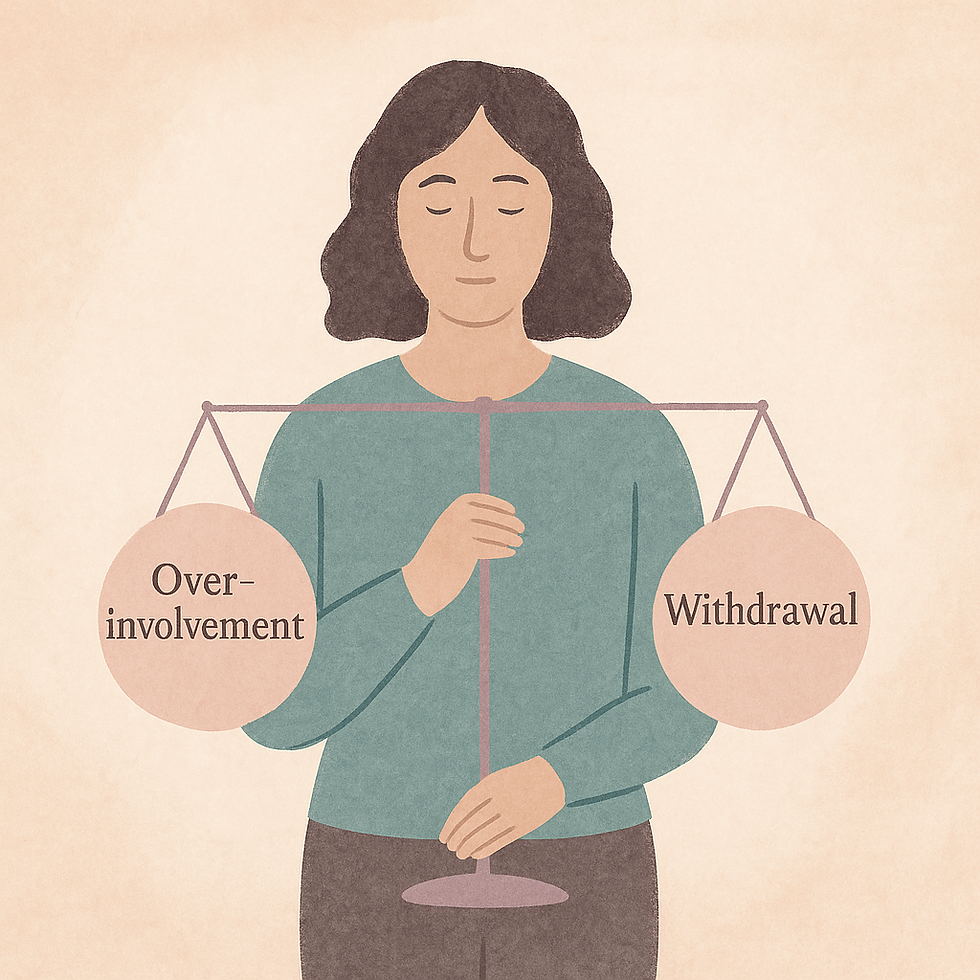
Many trainees and early-stage practitioners oscillate between:
Rescuer (over-involvement)
Security Guard (over-protection or over self-defence)
This is developmentally normal.
Example:
A client’s breath tightens while discussing a conflict. The trainee notices, softens their tone, slows their own breath, and says:
“I noticed something tightened just then.
Would it feel alright to pause here together for a moment?”
Relational pacing often means slowing, softening your tone, or creating more space so the client’s inner experience can unfold safely.
This is relational work in its smallest form.
Somatic example
The therapist gently grounds their feet, lengthens their exhale, and models regulation without speaking.
What to bring to supervision in this stage
Fears of saying too much or too little
Boundary questions
Interpersonal discomforts
Moments where you felt “too involved” or “too detached”
As therapists become more aware of themselves in the room, awareness naturally expands to include culture, power, and the potential for mistakes.
Phase 3: Cultural Uncertainty and the Fear of Mistakes
Most common fears include:
appearing ignorant
mispronouncing a name
offending a client
naming a difference incorrectly
asking “the wrong kind of question”
This often leads to:
avoidance
rigid adherence to technique
silence
shutting down curiosity
Supervision is essential here, because this is where shame, identity, and relational safety intersect.
Supervision in this stage helps you learn:
curiosity is safer than avoidance
imperfection is not harm
repair strengthens trust
cultural humility is honest, not expert-driven
This is where relational maturity begins.
Phase 4: Growing Into Relational Attunement
Attunement is often like tuning an instrument; both therapist and client subtly adjust until the emotional tone becomes clearer and more connected.
With time, practitioners begin to:
respond rather than perform
feel steady in silence
use tone, pace, and breath intentionally
integrate culture and identity naturally
name relational shifts gently
use themselves authentically and ethically appropriate
notice countertransference without panic/fear
The internal pressure softens. Intuition strengthens.
Working with Silence Example
Silence is not absence; in relational work, silence becomes an active space for co-regulation and emotional settling.
What to bring to supervision in this stage
micro-ruptures
cultural questions
times of effective presence
countertransference moments
Phase 5: Relational Presence (Mature Stage)
This is the long-term trajectory of relational development.
Here the therapist is:
steady, attuned, emotionally available
grounded in cultural, contextual, and systemic awareness
flexible in uncertainty
boundaried with clarity
able to hold power without dominating or disappearing
comfortable with repair
guided by integrity and humility
This is the quietly powerful relational stance.

Case Vignettes and Learning Anchors
Avoiding Culture Out of Fear
“I do not want to offend her.”
A trainee avoids asking a British-born Chinese client about her family dynamics for fear of “being insensitive.” The session becomes what is described, 'dry'.
In supervision, the trainee learns avoidance is communication. Curiosity, expressed gently, deepens safety.
The trainee returns to therapy and says:
“I noticed I hesitated last time… I wondered what that moment was like for you.”
Minority Therapist with Majority Client
A Pakistani-British therapist works with a White British client who says,
“I am not sure how much you will understand me.”
The therapist freezes.
Positionality affects both sides. Naming the moment invites honesty, not conflict.
The Rescuer vs The Guard
A first year psychologist trainee comforts excessively when a client cries. In the next session, the trainee becomes overly boundaried to “correct” themselves.
In supervision, they explore:
The own discomfort with distress, need to be “good”, and how to rebalance with reflection on the seesaw between over-involvement and over-correction.
Depth grows from understanding why the swing happened, not eliminating it.
Cultural Misattunement and Repair
A therapist repeatedly mispronounces a client’s name. When finally addressed, the therapist panicked. They then avoided addressing it for three sessions. When they finally bring it up, the client says,
“I did not know if it mattered to you.”
Repair is relational, not confessional. Small repairs strengthen trust.
This becomes a moment of relational honesty rather than shame.
From Technique to Presence
A trainee uses worksheets with a client, who says, “I do not feel I can do this right now.”
Presence before intervention. Attunement shows you how to pace the work.
Micro-Attunement in Real Time
A client looks down, voice softening.
The therapist pauses and says:
“I want to honour that shift. What happened inside just now?”
Relational work is often subtle. Attunement lives in the micro-moments.

How to Practise Relationally
Many trainees fear that relational therapy means being overly open or boundaryless.
Relational clarity requires steady boundaries, emotional presence, and self-reflection before speaking or self-disclosing.
It also involves using yourself gently and intentionally, grounding in supervision, tolerating uncertainty, recognising cultural lenses, and distinguishing attunement from countertransference.
Relational work is not self-exposure. It is self-awareness in the service of the client.
If You Feel Overwhelmed
It is normal to feel overwhelmed when learning relational practice.
Most trainees can feel unsure, afraid of mistakes, and worried they are “not relational enough”.
This discomfort is not failure, but a part of development.
Relational therapy is something you grow into, not something you immediately know how to do.

What To Bring To Supervision
Supervision is where relational development comes alive.
You can bring moments that:
stayed with you
felt confusing, shameful, or surprising
involved cultural uncertainty
evoked strong emotion
involved relational distance or closeness
involved ruptures or repairs
raised boundary questions
Supervision is where relational depth develops.
Reflective Questions for Practitioners
When do I notice myself performing rather than connecting?
Which cultural or power differences do I avoid naming?
Which emotions in clients do I struggle to stay with?
What do I fear in using myself relationally?
How do I respond when I make a mistake?
Which parts of myself feel underdeveloped or overprotected?
How does my identity shape the relational field?
All of these shape the therapist you are becoming, and they gather quietly over time into a grounded, relational way of being.

Conclusion: The “North Star” of Relational Therapy
If you have reached this point, I want to honour the openness it takes to reflect on who you are becoming as a therapist.
Relational therapy is the long practice of showing up with presence, humility, cultural awareness, emotional steadiness, and courage to repair.
It does not require perfection.
It requires willingness to remain human, reflective, and relational.
This is the steady North Star of relational practice:
To meet the client with attunement, grounded clarity, and cultural humility, even when you feel uncertain.
You do not simply learn relational therapy.
You grow into it.
The more you develop as a person, the more deeply you can accompany others in theirs.
If you would like to deepen this work through clinical supervision or relational training, you are welcome to be in touch to explore how I support practitioners in their development. I bring my experience as a relational, culturally attuned, trauma-informed psychologist committed to reflective growth.
You can also read my other guides and reflective pieces on
Author bio
Dr Tiffany Leung is a UK-based chartered psychologist with 14+ years of experience in therapy, clinical supervision, and training. She holds a Professional Doctorate in Counselling Psychology from the University of Manchester, where she is also an Honorary Lecturer in Intercultural Public Health. She works within the NHS and in independent practice, supporting clients in English, Cantonese, and Mandarin.
Clinical Supervision with Dr Tiffany Leung
I offer integrative clinical supervision to therapists, counsellors, and counselling psychologists working at the intersection of trauma, neurodivergence, and intercultural experience. My focus is on formulation as a live process, how clinical thinking develops as the work deepens, where it gets stuck, and what those sticking points reveal about both the client and our own frameworks.
This space is for clinicians ready to stay with complexity rather than resolve it prematurely: those working with late-identified neurodivergent adults, clients from bicultural and migration backgrounds, or cases where single-model formulation has reached its limits.
Dr Tiffany Leung · UK-based psychologist practising in Cantonese, Mandarin, and English · Honorary Lecturer in Intercultural Public Health, University of Manchester · NHS background in complex mental health.
Full reference list for relational therapy for therapists:
Relational & Psychodynamic Foundations
Mitchell, S. A. (1988). Relational Concepts in Psychoanalysis. Harvard University Press.
Stern, D. N. (2004). The Present Moment in Psychotherapy and Everyday Life. W.W. Norton.
Aron, L. (1996). A Meeting of Minds: Mutuality in Psychoanalysis. Routledge.
Benjamin, J. (2004). Beyond Doer and Done To. Psychoanalytic Quarterly, 73(1), 5–46.
Humanistic, Person-Centred & Experiential
Rogers, C. R. (1957). The necessary and sufficient conditions of therapeutic personality change. Journal of Consulting Psychology, 21, 95–103.
Gendlin, E. (1996). Focusing-Oriented Psychotherapy. Guilford Press.
Relational–Cultural Theory
Jordan, J. V. (2010). Relational–Cultural Therapy. American Psychological Association.
Miller, J. B. & Stiver, I. P. (1997). The Healing Connection. Beacon Press.
Attachment Theory
Bowlby, J. (1988). A Secure Base. Routledge.
Ainsworth, M. D. (1989). Attachments beyond infancy. American Psychologist, 44, 709–716.
Interpersonal Neurobiology & Neuroscience of Attunement
Schore, A. N. (2012). The Science of the Art of Psychotherapy. Norton.
Cozolino, L. (2016). The Neuroscience of Psychotherapy (3rd ed.). Norton.
Siegel, D. J. (2012). Pocket Guide to Interpersonal Neurobiology. Norton.
Trauma-Informed Approaches
Herman, J. (2015). Trauma and Recovery (rev. ed.). Basic Books.
van der Kolk, B. A. (2014). The Body Keeps the Score. Viking.
SAMHSA. (2014). Trauma-Informed Care in Behavioral Health Services.
Cultural Humility, Diversity & Anti-Oppressive Practice
Hook, J. N., Davis, D. E., Owen, J., Worthington, E. L., & Utsey, S. O. (2013). Cultural humility: Measuring openness to culturally diverse clients. Journal of Counseling Psychology, 60(3), 353–366.
Sue, D. W. (2015). Race Talk and the Conspiracy of Silence. Wiley.
Murphy-Shigematsu, S. (2018). From Mindfulness to Heartfulness: Transforming Self and Society with Compassion. Berrett-Koehler.
Therapeutic Alliance Research
Bordin, E. S. (1979). The generalizability of the psychoanalytic concept of the working alliance. Psychotherapy: Theory, Research & Practice, 16, 252–260.
Horvath, A. O., Del Re, A. C., Flückiger, C., & Symonds, D. (2011). Alliance in individual psychotherapy. Psychotherapy, 48(1), 9–16.
Norcross, J. C., & Lambert, M. J. (2019). Psychotherapy Relationships That Work (3rd ed.). Oxford University Press.
Wampold, B. E. (2001, 2015). The Great Psychotherapy Debate. Routledge.
Rupture & Repair
Safran, J. D., & Muran, J. C. (2000). Negotiating the Therapeutic Alliance. Guilford Press.
Safran, J. D., & Muran, J. C. (2010). Repairing Alliance Ruptures. American Psychological Association.
Corrective Emotional Experience
Alexander, F., & French, T. (1946). Psychoanalytic Therapy: Principles and Application. Ronald Press.
Developmental Pathways of Therapists
Stoltenberg, C. D., & McNeill, B. W. (2010). Integrated Developmental Model (IDM) for Supervising Counselors and Therapists (3rd ed.). Routledge.
Rønnestad, M. H., & Skovholt, T. M. (2013). The Developing Practitioner: Growth and Stagnation of Therapists and Counselors. Routledge.
Supervision Frameworks
Hawkins, P., & Shohet, R. (2012). Supervision in the Helping Professions (4th ed.). Open University Press.
Proctor, B. (2008). The three Rs of supervision: Restorative, normative and formative.
Relational Ethics
Knapp, S., Gottlieb, M. C., & Handelsman, M. M. (2017). Ethical Dilemmas in Psychotherapy. American Psychological Association.
Relational Therapy for therapists


Comments